Medicare and most major insurance accepted. We check your coverage before treatment; benefits vary by plan.
Still in Pain After a Knee Replacement? Genicular Artery Embolization Explained
Medicare and most major insurance accepted. We check your coverage before treatment; benefits vary by plan.
Explore genicular artery embolization in Kansas City at Restore Muscle and Joint.
You did everything right. You had the total knee replacement, you showed up for every physical therapy session, you pushed through the hard weeks — and months later the knee still aches, still swells, still wakes you up at night. You are not imagining it, and you are not alone.
Published outcomes consistently show that about 15-20% of patients report persistent pain a year or more after total knee arthroplasty (TKA), even when the hardware looks perfect on X-ray. For those patients, the surgeon's usual answer is "give it more time," another round of therapy, or a revision surgery nobody wants.
There is a third option that most Kansas City patients have never been told about: genicular artery embolization (GAE).
What GAE actually is
The lining of an irritated knee (the synovium) grows abnormal, leaky little blood vessels. Those vessels feed chronic inflammation and drag new pain nerve fibers along with them. That process — called neovascularity — does not care whether your knee is made of cartilage or cobalt-chrome. It can happen in an arthritic knee and it can happen around a well-placed implant.
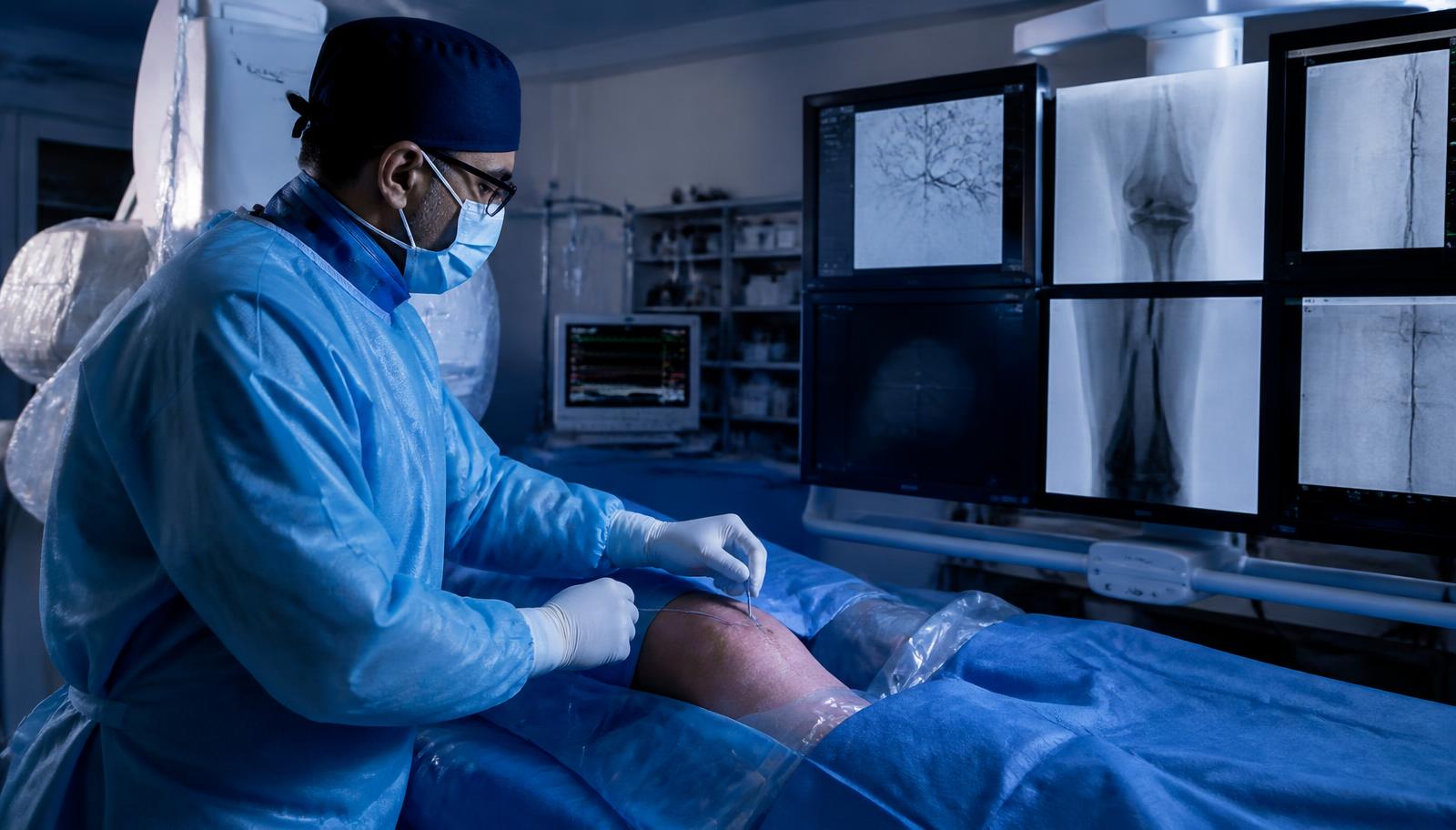
Genicular artery embolization shuts that supply line down:
- An interventional radiologist numbs a pinhole site at the wrist or groin.
- A catheter thinner than a coffee stirrer is guided to the genicular arteries around the knee using live X-ray.
- Contrast dye lights up the abnormal vessels feeding the inflamed tissue.
- Microscopic particles are released to block only those vessels — normal circulation is left alone.
- The catheter comes out. There is no incision, no stitch, and usually a small bandage.
Most cases run 60 to 90 minutes. You go home the same day, walk out on your own, and there is no hardware to recover from.
Why it matters after a knee replacement
A revision knee replacement is a major operation: another hospital stay, another 6-12 months of rehab, and outcomes that are generally less predictable than the first surgery. For patients whose implant is stable, aligned, and not infected, the pain generator is usually soft-tissue inflammation — exactly what GAE targets.
That makes GAE attractive when:
- The knee still hurts 6+ months after replacement.
- Imaging shows the implant is well-positioned and stable.
- Infection has been ruled out.
- Swelling, warmth, and night pain keep coming back.
- Cortisone helps for a few weeks, then fades.
- You have been told your only remaining option is revision surgery.
What the evidence shows
Studies of GAE in symptomatic knees — including a growing body of work on painful knees after arthroplasty — report meaningful pain reduction in roughly 70-85% of appropriately selected patients, with benefit measured at 12 months and beyond in longer follow-up series. Complication rates are low; the most common side effects are temporary skin discoloration over the knee, mild soreness, and small self-limited skin patches from particles reaching the surface.
GAE does not replace worn cartilage and it does not fix a loose or infected implant. What it does is turn down the inflammatory volume so the knee stops screaming.
What recovery looks like
- Day 0: procedure, a few hours of observation, home the same day.
- Days 1-3: mild soreness at the knee; walking is encouraged.
- Week 1: back to routine activity and desk work for most patients.
- Weeks 2-8: pain improvement builds gradually as inflammation settles. This is not an instant switch.
- Ongoing: we pair GAE with targeted physical therapy and rehabilitative therapy so the quad and hip strength you lost to years of guarding actually comes back.
Who is not a candidate
GAE is not appropriate if there is active joint infection, a loose or failing implant, severe peripheral arterial disease, or an untreatable bleeding problem. That is why our workup starts with imaging review and a vascular assessment — not a sales pitch.
Getting evaluated in Kansas City
Our genicular artery embolization program at 4119 NW Barry Rd in Kansas City evaluates patients from the Northland, Liberty, Gladstone, Parkville, and across the metro — including people who had their replacement somewhere else entirely. If GAE is not right for you, we will tell you, and we will point you toward SoftWave TRT, injections, or structured rehab instead.
Call 816-452-4488 or request an appointment. Bring your operative report and your most recent knee imaging if you have them.
This article is educational and is not medical advice. Candidacy for GAE is determined after clinical evaluation and imaging review.
Frequently Asked Questions
Get Your Free Consultation Today
No obligation. No pressure. Just a conversation about how we can help you live pain-free. Schedule your free consultation with our expert team now.
Request Your Appointment Today
Request a visit and our care team will call you within one business day to arrange your appointment.
Ready to talk to a specialist?
Our care team can help you explore your options and arrange an appointment that fits your needs.
Most major insurance accepted · 4119 NW Barry Rd, Kansas City, near Zona Rosa