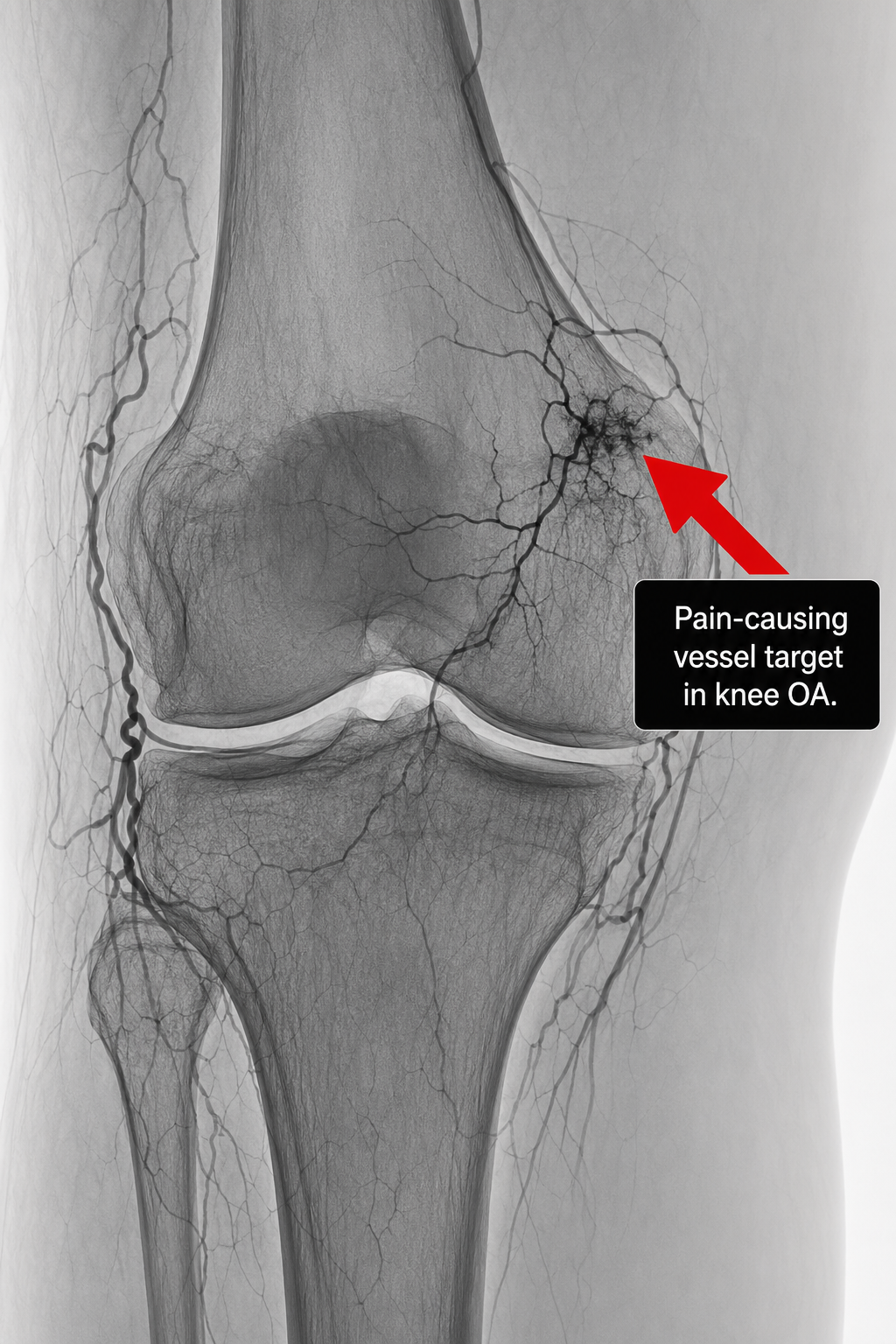
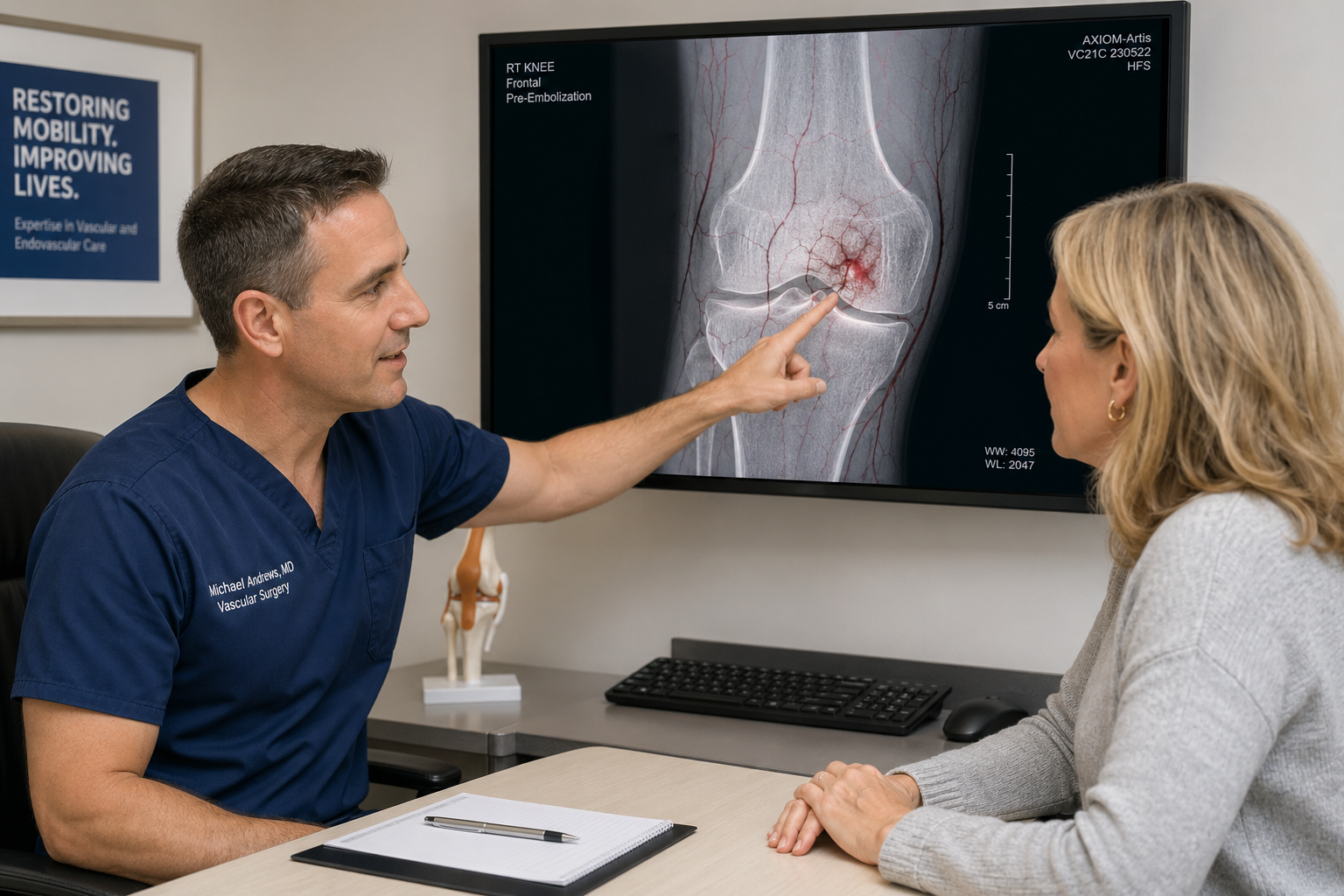
Recent clinical studies report encouraging improvements in knee osteoarthritis pain and function after genicular artery embolization. The Society of Interventional Radiology also supports GAE as an option for appropriately selected patients. Evidence is still evolving, and results vary. Research reviewed through October 31, 2026.
Society of Interventional Radiology supports GAE for selected patients
Position statement published online May 11, 2026 · Society announcement May 12, 2026
The Society of Interventional Radiology (SIR) provides evidence-based support for GAE as a minimally invasive option for symptomatic knee osteoarthritis when conservative treatment has failed and a patient is not a candidate for, or wishes to delay, knee replacement. SIR describes its role as a joint-preserving treatment directed at inflammatory and neurovascular contributors to pain.
What this support means: SIR considers GAE a viable option for appropriately selected patients when performed by trained interventional radiologists within a multidisciplinary care model. The statement also calls for larger randomized controlled trials. It is not a guarantee of relief, an endorsement of our clinic, or proof that GAE is better than every alternative. GAE does not rebuild lost cartilage.
2026 GAUCHO trial: improvements through twelve months
Correa and colleagues · CardioVascular and Interventional Radiology · June 29, 2026
In this prospective, single-blind randomized trial, 60 patients with mild-to-moderate knee osteoarthritis received GAE using either imipenem/cilastatin or permanent microspheres. The researchers reported significant clinical improvement over twelve months, with no statistically significant differences between the groups in pain outcomes. Average pain scores at twelve months were 3.95 and 3.88 out of 10, respectively.
What to keep in mind: Both groups received GAE. This study compared embolic agents, not GAE against a sham procedure, physical therapy or knee replacement. It therefore cannot establish superiority over those alternatives. The researchers reported no major differences in adverse events between the agents; that does not mean the procedure is risk-free.
Read “GAUCHO: 12-Month Clinical Results of a Single-blind Randomized Controlled Trial”2026 larger cohort: pain improvement with resorbable microspheres
Fleckenstein and colleagues · Radiology · June 2026
In this prospective observational study, 194 participants underwent 239 procedures using rapidly resorbable gelatin-based microspheres. Median pain decreased from 7 to 3 out of 10 at twelve months. Across the different KOOS symptom and function categories, 55%–80% of participants achieved improvements exceeding the minimum clinically important difference.
Temporary skin discoloration occurred after 15 procedures (6.3%), and one superficial groin hematoma was reported. These resolved without lasting effects; no moderate or severe adverse events were observed.
What to keep in mind: This was a single-center study without a control group, and 154 of 194 participants (79%) had twelve-month follow-up. Its results cannot establish benefit over sham treatment. The resorbable material may differ from what is used at our clinic.
Read “Genicular Artery Embolization Using Rapidly Resorbable Gelatin-based Microspheres for Osteoarthritis-related Knee Pain”2025 prospective study: sustained pain and function improvement
Sapoval and colleagues · CardioVascular and Interventional Radiology · August 6, 2025
This study included 50 treated knees in 46 patients using an ethiodized oil-based emulsion. Average pain on a 100-mm scale decreased from 71.8 at baseline to 37.8 at twelve months among the 37 observations with twelve-month pain follow-up. The average WOMAC score, which measures arthritis symptoms and function, improved from 52.7 to 29.0 among the 33 observations with twelve-month WOMAC follow-up.
No target-knee complications were reported. At twelve months, 17 of 37 participants (45.9%) reached the study’s acceptable symptom-state threshold; this is a specific symptom threshold, not a general success rate.
What to keep in mind: This was a single-center, open-label study without a control group, and not all participants had twelve-month measurements. Its embolic material may differ from the material used at our clinic.
Read “Genicular Artery Embolization using an Ethiodized Oil-based Emulsion in Fifty Knees: 12-Month Results”Why further controlled research matters
Positive findings from studies without a control group do not by themselves prove a benefit beyond placebo or other care. A 2026 randomized sham-controlled trial with 58 patients found that both GAE and sham groups improved at twelve months, with no statistically significant difference in pain, synovitis or other clinical outcomes. Its authors did not support clinical implementation based on their findings.
This mixed evidence is important to an informed decision. Your specialist can discuss potential benefits, procedure risks, alternatives and whether the published research applies to your knee condition. Individual outcomes are not guaranteed.
Earlier studies and academic resources