Most major insurance accepted.

Balance & Gait Therapy in Kansas City, MO
Fall prevention and walking retraining for older adults on NW Barry Rd. One-on-one physical therapy, vestibular care, and strength training — Medicare and most insurance accepted, same-week appointments.
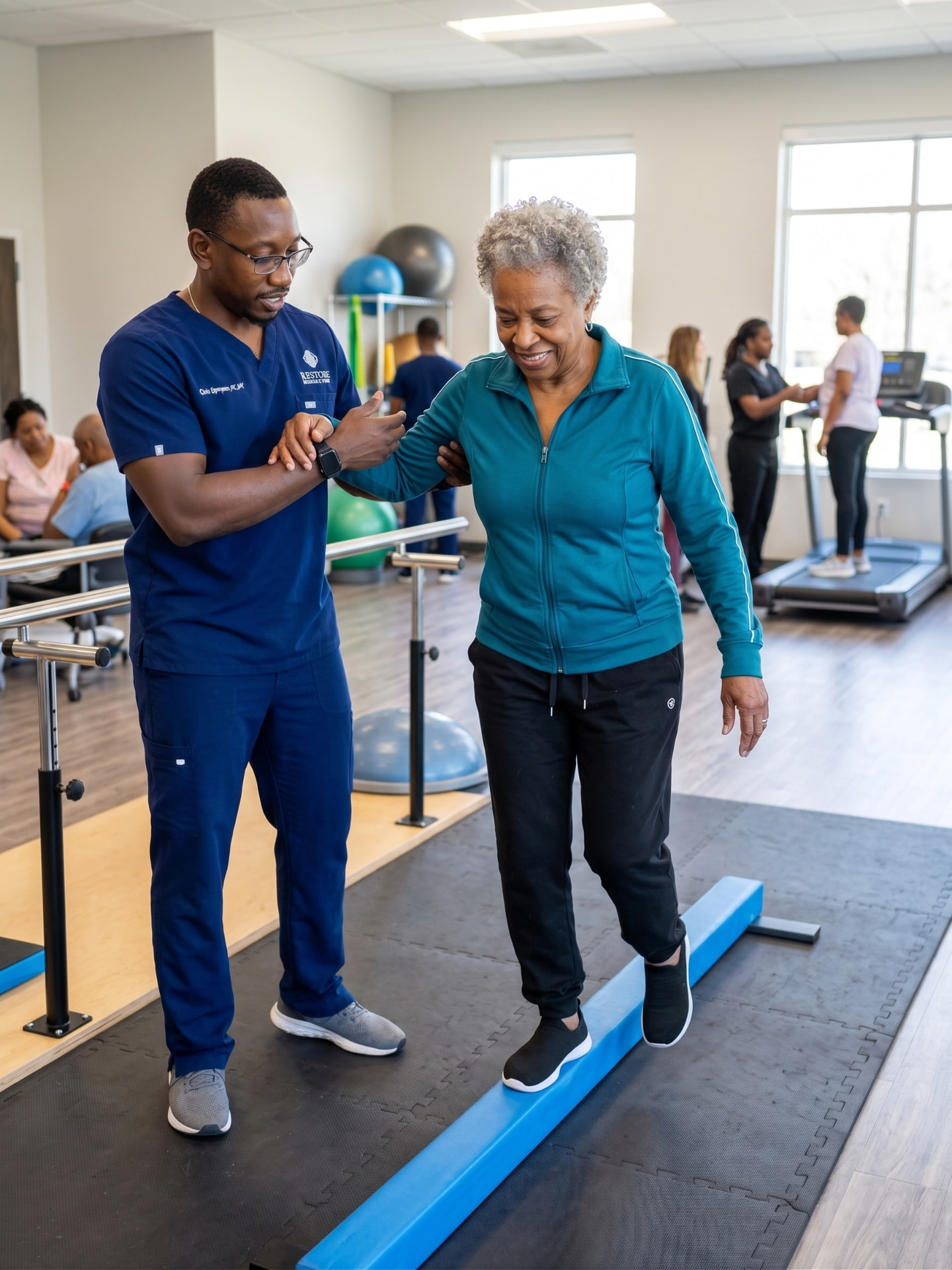
If you searched "balance therapy near me" or "fall prevention Kansas City" because you or a parent has started grabbing the wall, slowing down on stairs, or has already had a fall — Restore Muscle and Joint can help. Our clinic on NW Barry Rd. in Kansas City's Northland runs one-on-one balance and gait therapy with doctors of physical therapy, supported by chiropractic and medical care in the same building.
Unsteadiness is not simply "getting older." It is usually a fixable mix of leg weakness, stiff ankles and hips, slowed reaction time, inner-ear (vestibular) dysfunction, nerve changes in the feet, or medication side effects. According to the CDC, falls are the leading cause of injury for adults over 65 — and targeted balance training is one of the few interventions proven to reduce that risk.
Balance & Walking Problems We Treat
- Feeling unsteady on your feet or afraid of falling
- Holding onto walls, furniture, or counters to get around the house
- A shuffling, wide, or uneven walking pattern
- Dizziness or lightheadedness when standing up or turning your head
- One or more falls (or near-falls) in the past year
- Difficulty on stairs, curbs, uneven ground, or in the dark
- Numbness or burning in the feet that makes footing feel unreliable
- Trouble walking after a stroke, hip or knee replacement, or long illness
What's Actually Causing Your Balance Problem?
Balance is a system: your inner ear, your eyes, and the sensors in your feet, ankles, and spine all feed information to your brain, and your legs have to respond fast enough to keep you upright. A problem anywhere in that chain shows up as unsteadiness. We test each piece before we treat.
- Lower-body weakness — weak glutes, quads, and calves mean you can't catch yourself when your footing changes.
- Vestibular (inner ear) disorders — including BPPV and vestibular hypofunction. See our vertigo and vestibular therapy program.
- Peripheral neuropathy — numb feet stop reporting where the ground is. See our neuropathy treatment page.
- Knee, hip, and back pain — pain changes your walking pattern long before you notice it, and the compensation itself becomes a fall risk.
- Post-surgical deconditioning — hip or knee replacement, spine surgery, or a hospital stay that cost you strength and confidence.
- Neurologic conditions — stroke, Parkinson's disease, MS, and post-concussion balance loss.
- Medication side effects and blood pressure drops — dizziness on standing that we screen for and refer appropriately.
- Fear of falling — after one fall, people move less, get weaker, and become more likely to fall again. Breaking that cycle is part of care.
Most major insurance accepted.
Meet Your Kansas City Balance & Gait Team
Every balance session is one-on-one with a licensed provider — never handed off to an aide and a sheet of exercises.



Our 4-Step Balance & Fall Prevention Program
Step 1 — Measure Your Actual Fall Risk
We use standardized, repeatable tests — Berg Balance Scale, Timed Up and Go, gait speed, single-leg stance, and functional reach — plus a vestibular and sensory screen and a review of your medications and home setup. You get a number, not a guess.
Step 2 — Rebuild Strength and Mobility
Progressive physical therapy for the hips, quads, calves, and core, plus ankle and hip mobility work through rehabilitative therapy. Strength is the single biggest modifiable fall risk factor.
Step 3 — Retrain Balance and Gait
Parallel bars, balance beam and foam surfaces, perturbation and reaction training, head-turn and dual-task walking, stair and curb practice, and treadmill gait retraining — progressed as your scores improve, always with a therapist within arm's reach.
Step 4 — Make It Stick at Home
A home exercise program you'll actually do, assistive device fitting and training, footwear and home hazard guidance, and re-testing at set intervals so you and your family can see the fall risk dropping.
Why Kansas City Families Choose Restore for Balance Therapy
One-on-one with a doctor of physical therapy
Your full session is with a licensed provider — critical when the whole point is not falling.
Measured progress, not vague reassurance
Berg, TUG, and gait speed re-tested on a schedule so improvement is documented.
Vestibular care in the same building
Dizziness, BPPV, and inner-ear balance loss treated alongside strength and gait work.
Pain treated, not worked around
Knee, hip, and back pain that alters your walking is treated by our chiropractic and medical team.
Medicare and most insurance accepted
Including Medicare, Medicare Advantage, federal OWCP, and major commercial plans.
Northland convenience
4119 NW Barry Rd., Kansas City, MO 64154 — ground-level access and free parking.
Balance & Fall Prevention Across the Kansas City Metro
Older adults and their families come to our NW Barry Rd. clinic from across the Northland and the greater Kansas City metro for balance therapy and fall prevention:
Also serving Riverside, Weatherby Lake, Platte Purchase, Pleasant Valley, Claycomo, and North Kansas City. See our full service area.
Frequently Asked Questions
Where can I get balance therapy near me in Kansas City?
Restore Muscle and Joint provides one-on-one balance and gait therapy at 4119 NW Barry Rd., Kansas City, MO 64154, in the Northland. Our doctors of physical therapy run standardized fall-risk testing and build an individualized program for strength, gait, and vestibular function. Call (816) 452-4488 for a free assessment.
Does Medicare cover balance and gait therapy?
Yes. Medicare Part B covers medically necessary physical therapy for balance disorders, gait abnormalities, and fall prevention when there is a documented functional deficit. We verify your benefits and document the objective testing Medicare requires before you start.
Do I need a referral from my doctor?
Missouri allows direct access to physical therapy, so you can usually start without a physician referral. Some Medicare Advantage and commercial plans require one — our front desk checks your specific plan and coordinates the referral if it's needed.
How long does balance therapy take to work?
Most patients notice steadier walking within three to four weeks. A typical fall-prevention program runs six to twelve weeks at two visits per week, with re-testing every four weeks so you can see measurable change in your Berg Balance and Timed Up and Go scores.
What is the difference between a balance disorder and a gait disorder?
A balance disorder is difficulty keeping your center of gravity over your feet — feeling unsteady standing, turning, or on uneven ground. A gait disorder is an abnormal walking pattern such as shuffling, a wide base, limping, or foot drop. They frequently occur together, and our evaluation identifies which is driving your risk.
Can physical therapy actually prevent falls in older adults?
Yes. Supervised, progressive balance and strength training is one of the most strongly supported interventions for reducing falls in adults over 65. The key is that the exercises must be challenging enough to push your balance system and progressed over time — which is exactly what supervised therapy provides and generic home handouts do not.
My dizziness comes and goes when I roll over in bed. Is that treatable?
That pattern is classic BPPV, caused by displaced crystals in the inner ear. It is often resolved in one to three visits with repositioning maneuvers. See our vertigo and vestibular therapy page, or call us and we'll test for it at your first appointment.
I already use a walker or cane. Is therapy still worth it?
Absolutely. Many patients are using a device that is the wrong height or type, or using it in a way that increases fall risk. Therapy fits and trains your device correctly, and many patients progress to a less restrictive device — or off one entirely — as strength returns.
Do you treat balance problems after a stroke or with Parkinson's disease?
Yes. We provide neurologic gait and balance rehabilitation for stroke, Parkinson's disease, MS, and post-concussion patients, coordinating with your neurologist and focusing on functional, real-world walking and transfer safety.
Can neuropathy in my feet cause my balance problems?
Yes — numb feet can't tell your brain where the ground is, which is a major and often overlooked fall risk. We treat neuropathy alongside balance training and use sensory retraining and visual and vestibular compensation strategies to make up for lost foot sensation.
My parent already fell. What should we do first?
Get a fall-risk evaluation quickly. After one fall, the risk of another rises sharply, and the fear of falling itself leads to less activity and more weakness. Schedule a free assessment and we'll test balance, strength, vestibular function, and home hazards, then build a plan.
How soon can we be seen?
We hold same-week appointments for new balance and fall-risk patients. Call (816) 452-4488 or book a free consultation online.
Get Your Free Consultation Today
Take control of your balance and stay on your feet. Schedule your free fall-risk assessment today.
Request Your Appointment Today
Request a visit and our care team will call you within one business day to arrange your appointment.
Ready to talk to a specialist?
Our care team can help you explore your options and arrange an appointment that fits your needs.
Most major insurance accepted · 4119 NW Barry Rd, Kansas City, near Zona Rosa