Sciatica and Spinal Disc Decompression: What Finally Works When Stretching Doesn't
You feel it the second you stand up: a hot line of pain from your low back, through the buttock, down the back of the thigh, sometimes all the way into the foot. Sitting makes it worse. Coughing makes it worse. Nothing you do at home holds.
That is sciatica — and the single most useful thing to understand about it is that sciatica is a symptom, not a diagnosis. Something is irritating the sciatic nerve or the nerve roots that feed it. Until you know what, you are guessing.
What is actually compressing the nerve
Lumbar disc herniation or bulge (the most common cause). The disc's outer wall weakens, the inner material pushes backward, and it presses on the L4, L5, or S1 nerve root. Classic signs: worse with sitting, bending, and coughing; often better standing or walking.
Spinal stenosis. Narrowing of the canal, usually age-related. Classic signs: leg pain and heaviness that comes on with walking and eases when you sit or lean forward on a cart.
Degenerative disc disease. Loss of disc height narrows the opening the nerve exits through.
Spondylolisthesis. One vertebra slips forward on another, crowding the nerve.
Piriformis syndrome. The nerve is irritated by a deep hip muscle rather than the spine — a smaller share of cases, but real, and it responds to entirely different treatment.
Those five conditions produce nearly identical leg pain and need meaningfully different care. That is why our evaluation includes neurological testing, straight-leg raise and slump testing, reflex and strength grading, and imaging review when indicated — before anyone puts you on a table.
Why the stretches you found online often backfire
The most-shared sciatica stretch on the internet is a seated or lying knee-to-chest and figure-4. For a piriformis problem, fine. For a posterior disc herniation, deep lumbar flexion loads the exact direction that pushes disc material further back into the nerve. Patients regularly tell us they stretched faithfully for six weeks and got worse. They were not lazy — they were doing the wrong exercise for their diagnosis.
What non-surgical spinal decompression does
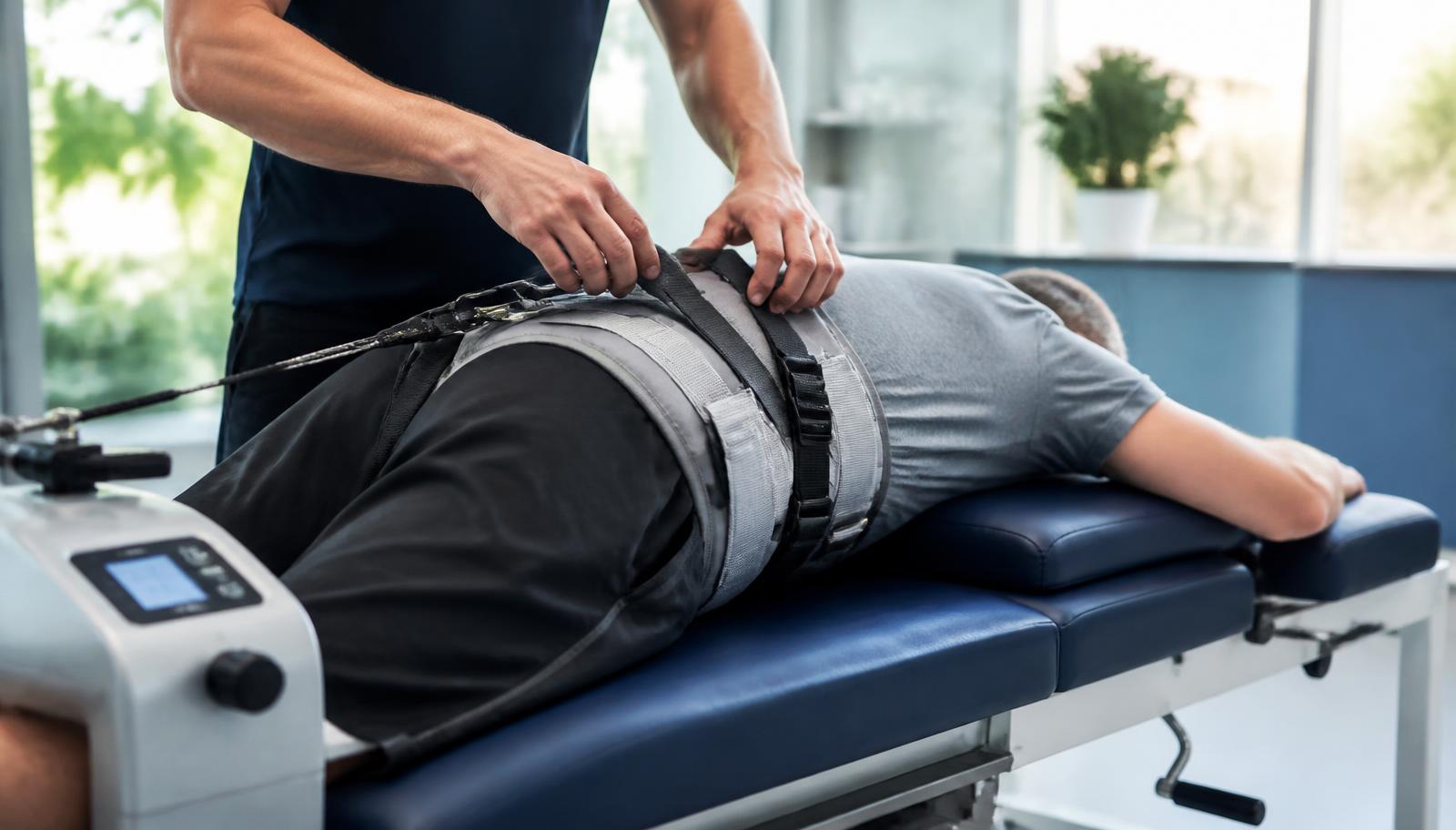
Spinal decompression is a computer-controlled traction therapy. You lie on a table, secured at the pelvis and trunk, and the system applies a precise, cyclical distraction force to a targeted spinal segment.
The intent is straightforward:
- Create negative pressure inside the disc, which can help draw herniated material inward and away from the nerve root.
- Open the space where the nerve exits, relieving mechanical compression.
- Improve fluid exchange into a disc that has almost no blood supply of its own, which is why discs heal so slowly.
- Do all of that without triggering the muscle guarding that ordinary pulling traction causes — the cycling force is what keeps the paraspinals from splinting.
A session takes about 20-30 minutes and is not painful. Most patients read or close their eyes. A typical course runs several sessions per week over 4-8 weeks, tapering as symptoms resolve.
Decompression alone is not the plan
Decompression relieves pressure. It does not, by itself, fix the reason your spine got there. Our disc therapy program combines decompression with:
- Directional preference exercise — usually extension-based for disc patients, the opposite of what most people are doing.
- Core and hip stabilization through rehabilitative therapy, because a weak deep core forces the disc to absorb load it should not.
- Manual therapy and chiropractic care to restore segmental motion above and below the involved level.
- Dry needling for the piriformis, glute medius, and QL guarding that piles on top of nerve pain.
- Ergonomic and lifting correction so eight hours of driving or desk work stops undoing your progress.
Realistic expectations
Most patients notice a change in leg pain — often "the pain is pulling back up toward my hip" — within the first two to three weeks. That centralization of symptoms is the single best predictor of a good outcome. Pain that retreats from the foot toward the back is progress, even if the back itself is still sore.
Decompression is not for everyone. It is not appropriate with spinal fusion hardware at the treated level, certain fractures, severe osteoporosis, spinal tumors, abdominal aortic aneurysm, or pregnancy. We screen for all of it.
Red flags — go to the ER, not a clinic
Seek emergency care immediately for loss of bowel or bladder control, numbness in the saddle/groin region, or rapidly progressing weakness in the leg or foot. Those can indicate cauda equina syndrome, which is a surgical emergency.
Get evaluated in Kansas City
We treat sciatica and disc problems at 4119 NW Barry Rd, Kansas City, MO 64154, serving the Northland and Liberty, Gladstone, Parkville, Smithville, and Leavenworth.
Call 816-452-4488 or request an appointment for a sciatica evaluation.
Educational content only; not medical advice.
Frequently Asked Questions
Get Your Free Consultation Today
No obligation. No pressure. Just a conversation about how we can help you live pain-free. Schedule your free consultation with our expert team now.
Request Your Appointment Today
Request a visit and our care team will call you within one business day to arrange your appointment.
Ready to talk to a specialist?
Our care team can help you explore your options and arrange an appointment that fits your needs.
Most major insurance accepted · 4119 NW Barry Rd, Kansas City, near Zona Rosa