Knee Pain After 60: How It Quietly Shrinks Your Life — and What Actually Reverses It
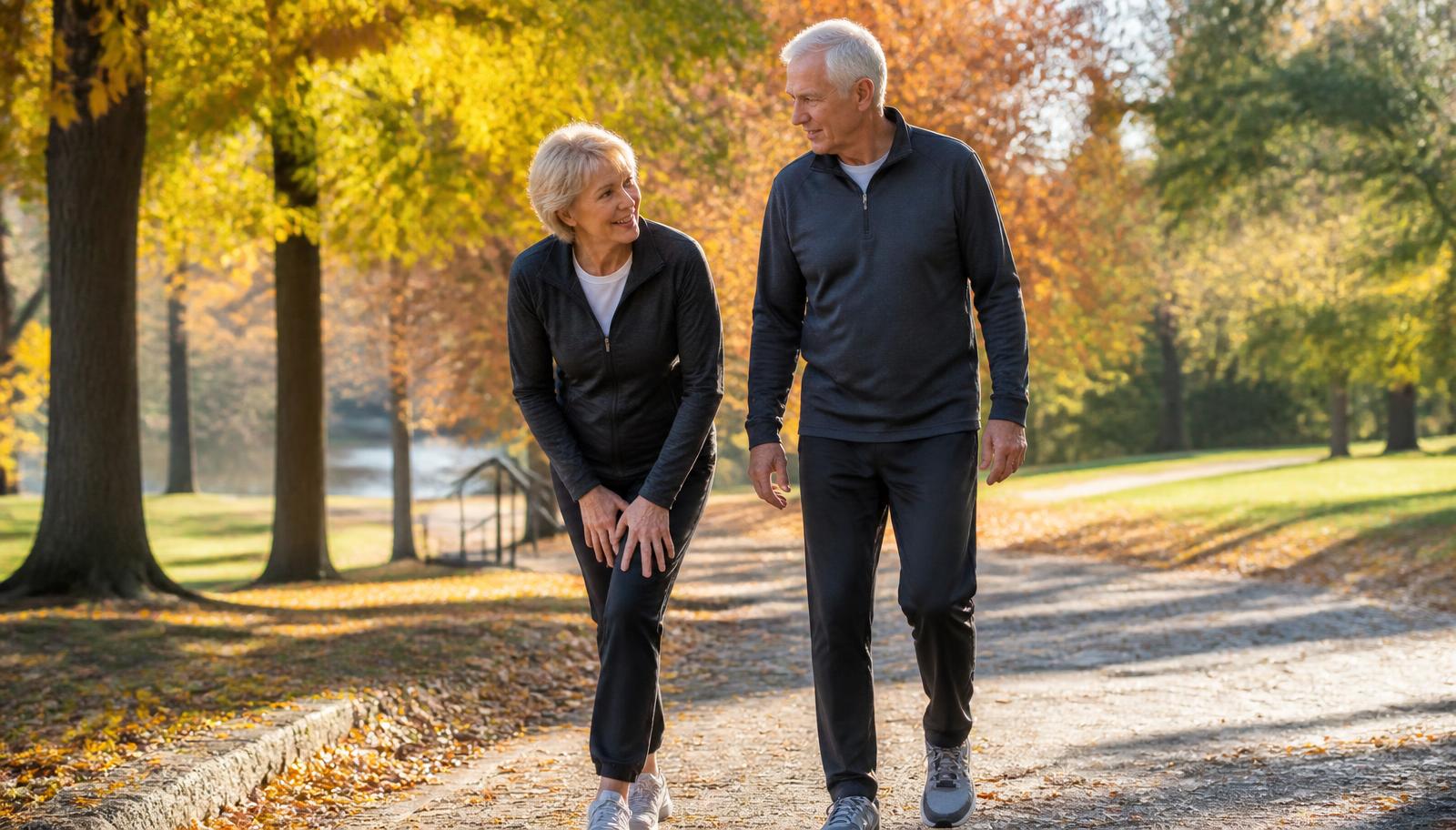
Ask a 68-year-old with bad knees what hurts and they will point to the joint. Ask what they have given up and the list is much longer: the garden, the grandkids' ballgames, the Costco trip, the church stairs, the walk they used to take every morning.
Knee osteoarthritis affects roughly one in three adults over 65, and it is the leading cause of mobility disability in older Americans. But the joint itself is only the first domino.
The cascade nobody warns you about
1. You walk less. Painful knees cut daily step counts dramatically. Less walking means less cardiovascular conditioning and lower endurance within weeks.
2. Your quads shrink. Quadriceps strength drops measurably in a painful knee. Weaker quads mean the joint absorbs more shock — which makes the pain worse. That is the loop.
3. Balance degrades. Weak legs and altered gait raise fall risk. Falls are the leading cause of injury-related death in adults over 65, and a hip fracture after 65 changes everything.
4. Sleep breaks down. Night pain and difficulty finding a comfortable position fragment sleep. Poor sleep amplifies pain perception the next day.
5. Weight climbs. Reduced activity plus unchanged intake adds pounds. Every extra pound puts roughly four pounds of additional load through the knee with each step.
6. Isolation sets in. Skipped outings become skipped weeks. Social withdrawal in older adults is strongly associated with depression and cognitive decline.
7. Medication risk rises. Long-term NSAID use in older adults carries real GI, kidney, and cardiovascular risk — especially alongside blood pressure medication.
None of that shows up on an X-ray. All of it shows up in quality of life.
Why "you're just getting older" is bad advice
Cartilage wear is common with age. Disabling pain is not inevitable. Plenty of people have moderate arthritis on imaging and walk three miles a day, and plenty of people with mild imaging findings can barely reach the mailbox. The difference is usually muscle strength, joint mechanics, inflammation load, and how long the problem went unaddressed.
Which means there is a lot to work with — even at 70, even at 80.
What actually helps
Strength work, correctly dosed
This is the single most evidence-supported intervention for knee osteoarthritis. Quadriceps, glute, and hip strengthening reduce pain and improve function in older adults, and strength is trainable at every age. The key is dosing it so it does not flare the joint. Our physical therapy and rehabilitative therapy programs are built around exactly this.
Gait and balance retraining
If you have started shortening your stride, gripping handrails, or turning in a wide circle instead of pivoting, your nervous system has already adapted around the pain. Our gait and balance program retrains those patterns and directly addresses fall risk.
Manual therapy and joint mobilization
Hands-on care to the knee, hip, and ankle restores accessory motion and reduces protective muscle guarding, making strengthening tolerable. See chiropractic care.
SoftWave TRT
Acoustic wave therapy stimulates circulation and the body's own repair response in chronically irritated tissue. It is drug-free, takes about 15 minutes, and requires no downtime — a good fit for patients who cannot tolerate NSAIDs. See SoftWave TRT.
Supartz viscosupplementation
A series of injections that supplement the joint's natural lubricating fluid. Useful for moderate arthritis in patients wanting to delay replacement. See Supartz knee treatment.
Genicular artery embolization (GAE)
For persistent inflammatory knee pain that has failed injections and therapy, GAE blocks the abnormal blood vessels feeding the inflammation through a pinhole — no incision, same-day discharge. It is a particularly good conversation for seniors who are not surgical candidates or who simply do not want a replacement. See genicular artery embolization.
A realistic 90-day plan for an older adult
- Weeks 1-2: Evaluation, pain control, joint mobilization, and daily isometric quad work. Establish a walking floor — even 10 minutes.
- Weeks 3-6: Progressive loading: sit-to-stands, step-ups, hip abduction. Add balance drills. Consider SoftWave if pain is limiting progress.
- Weeks 7-12: Build endurance, add stairs and uneven surfaces, reassess strength and gait objectively. Escalate to injection or GAE conversation only if progress has stalled.
The goal is not a perfect X-ray. The goal is getting back on the church stairs.
Talk to us in Kansas City
We treat knee pain in older adults at 4119 NW Barry Rd, Kansas City, MO 64154, and serve patients throughout the Northland including Liberty, Gladstone, Smithville, and Parkville. Medicare patients welcome.
Call 816-452-4488 or request an appointment.
Educational content only; not medical advice.
Frequently Asked Questions
Get Your Free Consultation Today
No obligation. No pressure. Just a conversation about how we can help you live pain-free. Schedule your free consultation with our expert team now.
Request Your Appointment Today
Request a visit and our care team will call you within one business day to arrange your appointment.
Ready to talk to a specialist?
Our care team can help you explore your options and arrange an appointment that fits your needs.
Most major insurance accepted · 4119 NW Barry Rd, Kansas City, near Zona Rosa